
Fundraising is under pressure. Manual operations are holding it back.
The full text of Titanbay's annual study of how private markets operations really run, based on 110 professionals across Europe. Published November 2026.
Foreword from our Co-CEOs
Private markets have a plumbing problem.
Private markets fundraising remains challenging. Global capital raised was down 12.7% and the number of funds closed fell 37% in the 12 months to 30 June 2026, according to PitchBook.1 Managers are widening their search for capital: new channels, new structures, new investors. All of it assumes the operations underneath can take the weight.
They can't. Not yet.
We asked more than 100 private market professionals how their operations actually run. 70% of asset managers say operational complexity has already limited the markets they can reach, delayed a fundraise or narrowed the investors they can serve, or expect it to. 45% say it has already happened. When every investor counts, that matters.
The cause, mostly, is how the work is set up. 55% of asset managers say most of their core fund processes still rely on manual steps. As the work grows, they add people to keep pace. 50% work with four or more outside providers to run a fund. The effect is clearest in wealth: it takes 58% of asset managers that distribute through wealth managers three months or longer to bring on one new distribution partner.
Yet only 9% of asset and wealth managers plan major investment in their operations over the next two years. None of this is a scandal. Spreadsheets got private markets this far. In a harder fundraising market, how much further can they take it? We're biased, obviously. We built Titanbay to be the infrastructure for private markets funds, because we think funds should run on purpose-built technology, not on PDFs, email and goodwill. This survey is our attempt to measure how far the industry has to go. We think there's a long way to go and this is just the start.
Thank you to everyone who took part.
Michael Gruener
Ossama Soliman
Co-CEOs, Titanbay
The story on one page
Fundraising is hard. Operations are making it harder.
Asset managers have more channels to raise money than ever. Our survey points to the root cause holding them back: the manual work behind each fund. Few are investing to change it.
Fundraises get harder when operations fall behind
Fundraises are delayed, markets stay closed and investor bases narrow. Most asset managers have experienced it, or expect to.
of asset managers have experienced or expect operational complexity to limit markets, delay a fundraise or narrow their investor base.
Core fund processes are still manual
Subscriptions, capital calls, reporting and KYC are still handled by hand, over email and in spreadsheets.
of asset managers still run most core fund processes manually or by email and spreadsheets.
Distributors take longer to bring on board
Wealth is another channel to raise money, but the speed of onboarding each new partner is key. Every quarter spent is a quarter its clients can't invest.
of asset managers selling through wealth take three months or more to onboard one distribution partner.
Few are investing to fix it
The pressure is visible across the market. Investment to match it is still the exception.
of asset and wealth managers plan major investment in their operations over the next two years.
70% of asset managers affected or expecting to be. Only 9% of asset and wealth managers investing to fix it.
Fundraising is hard. Operations are making it harder.
Against this backdrop, new research from Titanbay suggests that operational complexity is creating an additional obstacle for asset managers seeking to raise capital and expand their investor base.
global private markets capital raised, 12 months to 30 June 2026.2
number of funds closed, 12 months to 30 June 2026.2
70% say operational complexity has limited their target distribution markets, delayed a fundraise, reduced the investor types they work with, or expect it to. 45% already have, and 41% have more than once.
A further 25% of asset managers haven't been held back yet, but expect to be.
Base: 44 asset managers and GPs. Figures may not sum to 100% because of rounding. Source: Titanbay, State of Private Markets Operations 2026.
70% have been held back by operations, or expect to be
Operations get filed under cost. Our data says it belongs under growth.
When a fundraise slips, a market stays closed or an evergreen fund needs workarounds to stay open, that isn't a back-office budget line. It's revenue the firm never gets the chance to earn.
“Fundraising is already challenging for asset managers. In that environment, firms need to make it as straightforward as possible to bring new investors into their funds and establish distribution relationships. But the operational demands of serving a broader investor base can be significant. If firms cannot onboard new partners efficiently or support different investor types, they risk creating additional barriers to their own fundraising efforts.”Michael Gruener, Co-CEO, Titanbay
The research suggests that many firms still rely on processes that make it difficult to scale.
Running a fund: people and spreadsheets
The results of the survey reveal that most of the work behind a private markets fund still runs on people, spreadsheets and outside providers, rather than on infrastructure.
Manual by default
55% of asset managers say most of their core fund processes, such as subscriptions, capital calls, investor reporting and KYC, are still handled manually or by email and spreadsheet. 32% say almost all of them are. Just 11% say manual work is limited to less than a quarter of them.
54% of wealth managers say most of their core processes are still run by hand.
54% of asset and wealth managers still run most core processes by hand
Base: 44 asset managers and GPs; 28 wealth managers with a live offering. Source: Titanbay, State of Private Markets Operations 2026.
Private markets run on rules. Most of them still live in spreadsheets.
Every fund is a rulebook: who can invest, on what terms, under which regulation. Today most of those rules sit in documents, and people enforce them by hand, one check at a time. That holds for a flagship fund with a few hundred institutional investors. It breaks for vehicles built for scale, where the same checks have to run for thousands of investors on every dealing day. That's exactly where the industry is heading.
Hiring to keep up
When the workload grows, asset managers add people. 59% grew their operations headcount in the past 12 months specifically to manage fund operations workload. 34% scaled without adding headcount, and only 7% reduced it through technology or outsourcing.
When the workload grows, asset managers hire
Base: 44 asset managers and GPs. Source: Titanbay, State of Private Markets Operations 2026.
“Semi-liquid and wealth vehicles require monthly NAVs, continuous subscriptions, working redemption mechanics, transfer agency, and KYC and tax reporting at thousands of holders rather than hundreds. That isn't fixable with headcount.”Asset manager
Spread across many hands
50% of asset managers use four or more separate external providers to run their fund operations, across AIFM, fund administration, legal, audit, custody and technology. 16% use six or more. Only 9% handle it mostly in-house. Outsourcing is growing across the industry too: third-party management companies now run 19% of the assets managed by Luxembourg ManCos, up from 6% in 2018.3
50% of asset managers use four or more external providers
Base: 44 asset managers and GPs. Source: Titanbay, State of Private Markets Operations 2026.
“Asset managers cannot afford for operational complexity to become another barrier to fundraising. Many of the processes involved in launching and running private market funds were not designed for the scale or breadth of distribution that firms are now seeking. Relying on manual processes and disconnected providers makes it harder to onboard investors, manage fund operations and support distributors efficiently. Technology needs to do more than digitise individual tasks: it should connect the fund structure, regulatory oversight and operational processes so that managers can grow without adding complexity at every stage.”Ossama Soliman, Co-CEO, Titanbay
The cost: a quarter per distributor
A fund that runs on people moves at the speed of people. The cost shows up most clearly in distribution.
Of the asset managers that distribute through wealth channels, 58% say it takes three months or longer to fully onboard a single new wealth manager or private bank as a distribution partner. 16% say six months or more.
Onboarding time matters because distribution builds partner by partner. Every quarter spent bringing one distributor on board is another quarter in which that distributor's clients can't invest.
take three months or more to onboard one distribution partner.
58% take three months or more to onboard one distribution partner
Base: 38 asset managers that distribute through wealth channels. Source: Titanbay, State of Private Markets Operations 2026.
Wealth managers: borrowed systems
Wealth managers, private banks and family offices show the same pattern. 78% of the wealth managers we surveyed have some form of private markets offering, from a full shelf to occasional access.
Technology built for public markets
Only 18% have technology built for private markets. 43% have mostly adapted public markets systems, 14% have adapted them entirely, with significant workarounds, and 25% run private markets on separate, disconnected systems.
Only 18% have technology built for private markets
Base: 28 wealth managers, private banks and family offices with a live private markets offering. Source: Titanbay, State of Private Markets Operations 2026.
Evergreen, made to work by hand
75% already offer evergreen or semi-liquid funds. 43% offer them smoothly, 32% offer them with workarounds, and 14% say operational complexity is an active barrier, or the main reason they haven't launched.
Evergreen funds carry their own load: subscriptions and redemptions on every dealing date, for every client, often across several funds. When redemptions spike, that load multiplies. In June 2026, Partners Group applied its Global Value SICAV's 5% quarterly redemption limit after requests reached about 9.8% of net asset value.4 When a fund caps withdrawals like this, investors get back only part of what they asked for. Every wealth manager with clients in that fund then has to work out each client's share, explain it to them and process it, one client at a time.
75% already offer evergreen or semi-liquid funds
“Evergreen: Expanding access to individual wealth channels introduces frequent subscription and redemption cycles that traditional fund accounting struggles to process.”Asset manager
Base: 28 wealth managers, private banks and family offices with a live private markets offering. Source: Titanbay, State of Private Markets Operations 2026.
Manual here too
54% say most of their private markets processes, such as subscriptions, redemptions, client onboarding and reporting, are still handled manually or by email and spreadsheets. Only 39% can show clients' private and public holdings side by side in their main system; 43% can only with manual adjustments.
Confident, but stretched
79% say their operations could keep pace if client demand doubled tomorrow, but only 29% say they could do it easily. 50% would need some extra resource, and 21% say they would need significant investment or couldn't scale at all.
“Demand is not the problem. Every asset manager and private bank I speak to wants to put more private markets in front of more clients. What slows them down is what happens after that decision: structuring the right vehicle for the right investors, and then letting clients get in, and out, without weeks of manual work in between. Evergreen funds make this sharper. When clients can come and go every month or quarter, every subscription and every redemption is an operational event. Most of those orders travel through omnibus accounts, too, so they have to be aggregated on the way into the fund and broken back down to each client on the way out. The firms that get this right, step by step, are the ones that will win the clients.”
Base: 28 wealth managers, private banks and family offices with a live private markets offering; 21 of them offer evergreen or semi-liquid funds. A small base, so figures are best read as direction rather than precision.
Across the market: what the service providers see
Service providers, law firms and consultants see across many firms at once. Their view confirms the pattern across the market.
name operational infrastructure as the most common barrier to their clients' private markets growth, more than twice as many as name regulatory complexity (17%).
70% say operational constraints cause their clients' deals, fund launches or distribution relationships to stall or fail at least occasionally.
On evergreen and semi-liquid products, 50% say some of the firms they work with are ready but most aren't, and 33% say few or none are. Only 3% say most are ready.
Service providers name operational infrastructure as the top barrier
Only 3% see most of the firms they work with as ready for evergreen
Base: 30 service providers, law firms and consultants.
Base: 30 service providers, law firms and consultants. Source: Titanbay, State of Private Markets Operations 2026.
Firms are asking for help
90% of service providers say demand from private markets firms for partners like them has grown over the past two years: 40% significantly and 50% slightly. 53% expect private markets firms to turn mostly to external partners over the next two years, and 43% expect a mix of building in-house and outsourcing.
Demand for partners like theirs has grown over the past two years
Base: 30 service providers, law firms and consultants. Source: Titanbay, State of Private Markets Operations 2026.
“Fragmentation and manual nature of the private-markets operating model. Onboarding, subscriptions, capital calls, transfers, distributions, servicing and reporting still rely on heavily bespoke workflows, multiple intermediaries, disconnected systems and manual data reconciliation. This creates a compounding problem for GPs looking to broaden into wealth channels and more cross-border distribution - the operational complexity grows faster than the underlying assets.”Service provider
The perception gap: confidence isn't the same as readiness.
79% of wealth managers say they could cope if demand doubled, yet 82% run private markets on systems built for something else, and most of that confidence rests on adding resources. The service providers who see across the whole chain are far less sure. Our money is on the service providers. That isn't a criticism of wealth managers. It's a statement about the systems they've been given, which hold until volumes double, and then don't.
Read together, the chain runs on people: spreadsheets and hiring for asset managers, workarounds for wealth managers, and too many hand-offs in between. None of it was built for the volumes private markets are starting to bring.
What happens next: no fix planned yet
Firms recognise the problem. 43% of asset and wealth managers rate operational complexity a major barrier to growing their private markets business (4 or 5 on a five-point scale). The investment to match it is still the exception.
plan major investment in their private markets operational infrastructure over the next 24 months.
29% plan moderate changes, 25% minor optimisation, 24% no changes at all and 14% don't know. Where change is planned, growth drives it, not regulation.
Only 9% plan major investment in their operations
Figures may not sum to 100% because of rounding.
The main reason for planned change is growth in private markets volume (28%), ahead of demand for evergreen and new products (18%), cost reduction (13%), new technology becoming available (13%), regulatory requirements (10%) and competitive pressure (4%).
Where change is planned, growth drives it, not regulation
Base: 80 asset managers and wealth managers. Source: Titanbay, State of Private Markets Operations 2026.
How firms will close the gaps
Asked how they will close operational gaps, 50% expect a combination of building in-house, outsourcing and investing in technology. 21% plan primarily to build in-house, 14% to outsource and 10% to invest primarily in technology.
Service providers expect firms to lean further on outside help than firms themselves plan to: 53% of providers expect firms to turn mostly to external partners, while 14% of firms plan to. That is a gap worth watching.
Building in-house is a reasonable instinct. It's also a bigger job than it looks.
The work in question isn't a feature. It's regulation, investor eligibility and investor terms, turned into rules a system can follow, and kept current across every vehicle and jurisdiction. That's a lot to build for one firm's funds, and a lot to maintain once you have.
“Regulation is where building in-house gets hard. Every vehicle sits under a stack of rules: the fund regime, investor eligibility and the marketing rules in every country it's sold into. Those rules keep changing. Keeping them current, and being able to show a regulator that you have, isn't a project. It's a permanent job. It's important to take a moment to consider whether this is the kind of work your team wants to own in the long run.”Noel Moloney, Managing Director, Titanbay's AIFM
Our view: operations will decide who wins
Titanbay's viewThe access debate is over. The operations debate has barely started.
Private markets have done the hard part. The rules exist, the products exist and the demand is real. What most firms don't have yet is the infrastructure to serve that demand at scale.
This survey shows an industry filling the gap with people. 59% of asset managers added operations headcount last year, while only 9% of asset and wealth managers plan major investment in their operations. That leaves skilled people checking documents, rekeying data and chasing emails. The answer isn't fewer people. It's giving them infrastructure that lets them spend their time on investors and clients.
of asset managers added operations headcount last year.
of asset and wealth managers plan major investment in their operations.
1. Operations is now a distribution problem
When onboarding one distributor takes 58% of asset managers three months or more, and 70% of asset managers have been held back or expect to be, operations is setting the pace of growth. That makes it a board-level issue, not just a back-office one.
Ask: how long does it take us to onboard a distributor, and how many fundraises have operations delayed or narrowed in the past two years?
2. Volume needs systems, not just people
Evergreen and wealth vehicles mean continuous dealing for thousands of holders, not quarterly calls for hundreds. If every process runs on a person, every rise in volume means more checking and rekeying, and less time for the work only people can do.
Ask: which of our processes would we still run by hand if volumes doubled, and why?
3. More providers is not more infrastructure
50% of asset managers rely on four or more outside providers. Every hand-off between them is an email, a reconciliation and a delay. Outsourcing a manual process moves the spreadsheet. It doesn't remove it.
Ask: how many hand-offs does one subscription pass through before it settles?
4. Fix the connection, not just the ends
Wealth managers are stretching systems built for public markets. Asset managers are hiring. Neither side can solve this alone, because the friction sits in the connection between them. The fix is shared standards and data that moves through purpose-built technology, rather than as PDFs and email.
Ask: what do we still exchange with our partners by PDF, spreadsheet or email?
The cost of waiting
Waiting feels safe because today's model still works, by hand. But the service providers who see across the market rank operations well ahead of regulation as the barrier to growth, and only 3% say most of the firms they work with are ready for evergreen. The firms that fix operations first will onboard distributors faster, launch evergreen funds sooner and absorb growth without adding headcount for every step. Those who don't will find that growth arrives faster than their operations can keep up. That looks like: fundraises slipping, markets staying closed, or workarounds bolted onto an evergreen fund, just to stay open. That means lost revenue opportunities.
Base: 30 service providers, law firms and consultants. Source: Titanbay, State of Private Markets Operations 2026.
Spreadsheets got private markets this far. Infrastructure will take it the rest of the way.
The infrastructure for private markets funds.
Titanbay structures, launches, runs, and trades private markets funds in one place, on purpose-built technology that didn't exist until we built it.
- Structure
- Launch
- Run
- Trade
For asset managers, we take care of everything it takes to bring a private markets fund to market and keep it running: the structure, the AIFM, the regulation, the operations, and the technology. One firm, rather than a chain of providers handing work between them.
For wealth managers and private banks, we give access to third-party funds and the infrastructure to trade them at scale, through the systems they already have. We also make it simple to launch vehicles of their own, without becoming a fund manager.
The rules that govern each fund, who can invest, on what terms, under which regulation, are built into our technology rather than kept in documents. So they're applied the same way every time, and people can focus on investors and clients instead of checking.
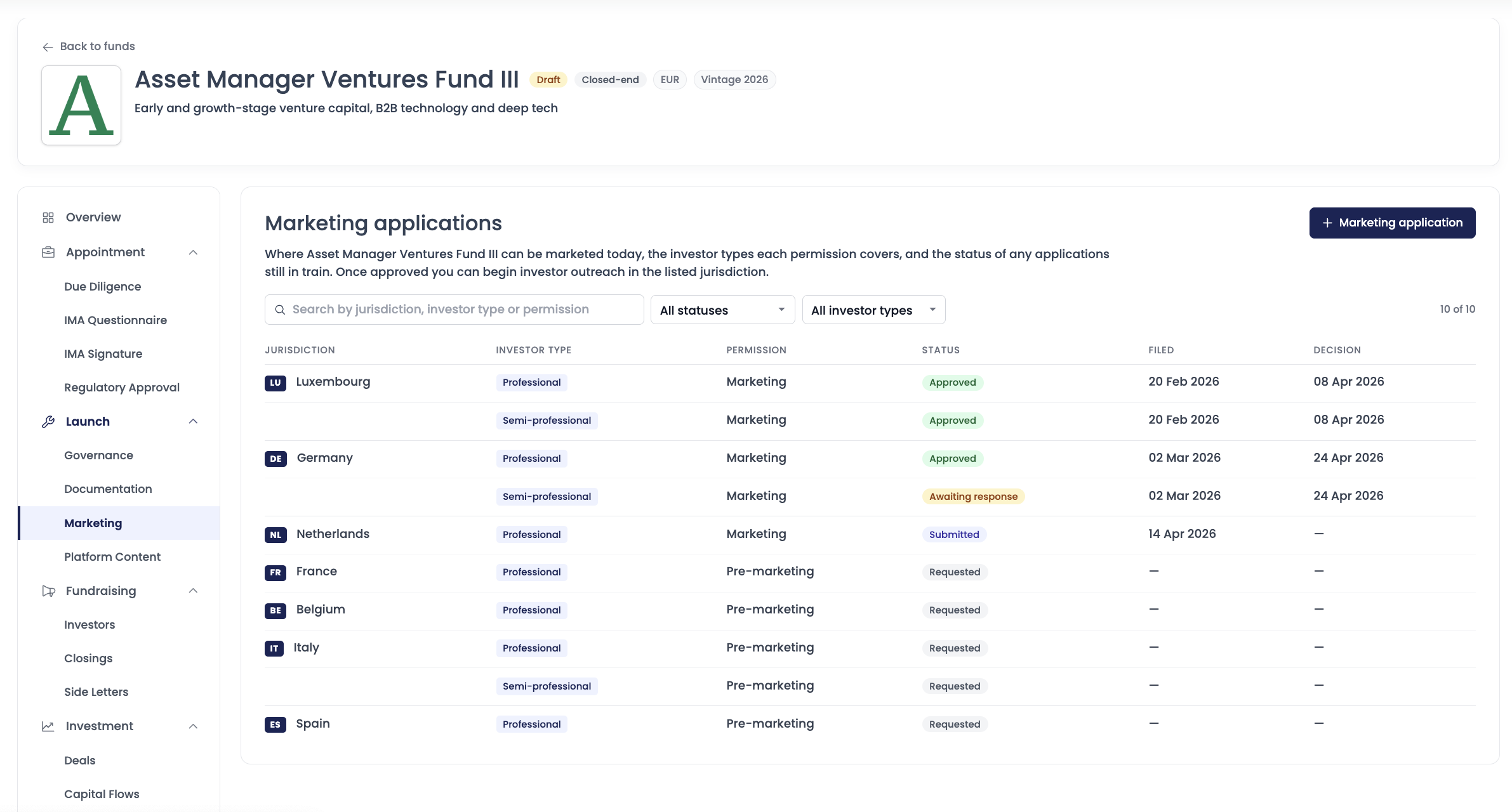
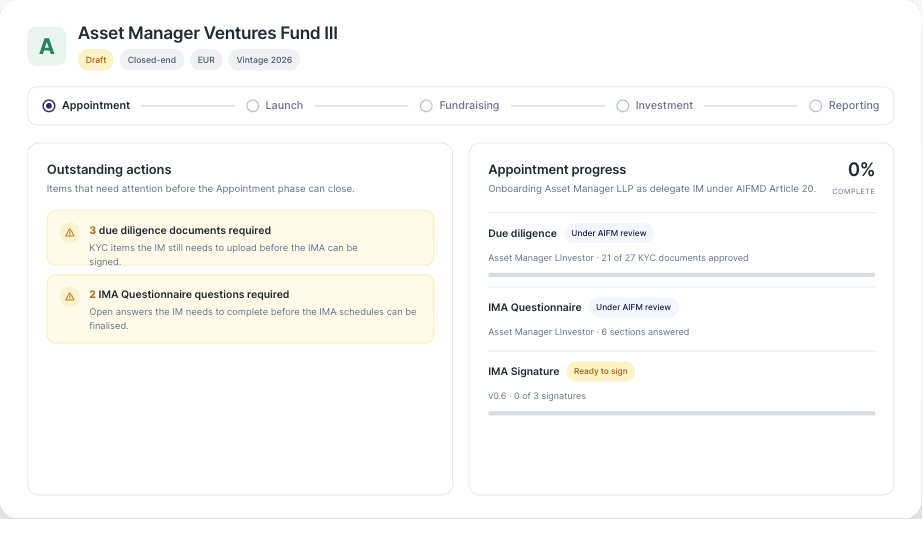
Other providers do one piece of the puzzle and hand off the rest. We do all four. In one place. That's the whole point.
About the research
The State of Private Markets Operations 2026 survey was run online by Titanbay in Autumn 2026. It gathered 110 responses from private markets professionals across Europe: 44 at asset managers and GPs, 36 at wealth managers, private banks and family offices (28 with a live private markets offering and 8 yet to launch), and 30 at service providers, law firms and consultants.
Service providers comprised 13 law firms and consultants, 6 technology providers and fund administrators, 1 placement agent and 10 other providers.
Respondents were based in the UK (39), Switzerland and Liechtenstein (29), Germany (15), France (3), Italy (1) and elsewhere in Europe (23).
Respondents by role
| Function | Respondents | Share |
|---|---|---|
| Senior leadership | 28 | 25% |
| Commercial and distribution | 24 | 22% |
| Operations | 14 | 13% |
| Product | 14 | 13% |
| Trading | 4 | 4% |
| Compliance and regulation | 4 | 4% |
| Technology | 4 | 4% |
| Other | 18 | 16% |
Asset and wealth managers by private markets assets under management
| Private markets AUM | Asset managers | Wealth managers |
|---|---|---|
| Under €500m | 11 | 5 |
| €500m to €2bn | 8 | 5 |
| €2bn to €10bn | 5 | 10 |
| €10bn to €100bn | 10 | 5 |
| Over €100bn | 10 | 6 |
| Prefer not to say | 0 | 5 |
Size bands as reported by respondents. Wealth managers include those yet to launch. Service providers were not asked.
Respondents were invited from Titanbay's professional network and reached through social media and industry events. They are a cross-section of the market, and most are not Titanbay clients. The sample is self-selected and results are unweighted. Responses were anonymous, and percentages are based on those who answered each question and rounded to the nearest whole number. Figures may not sum to 100% because of rounding. Quotes are verbatim and attributed by segment only.
Wealth managers were routed by whether their firm currently offers private markets products to clients, which covers anything from a full shelf to occasional access. Firms with no engagement in private markets had no separate route, so the wealth findings describe firms that offer or are exploring private markets, not the wealth market as a whole. Service providers answered about the firms they work with rather than their own firm.
Market data
Figures on the wider market come from third-party sources, not our survey:
- PitchBook, Q2 2026 Global Private Market Fundraising Report, 3 September 2026: private markets capital raised and funds closed.
- PwC Luxembourg, Observatory for Management Companies 2026 Barometer, 15 June 2026: third-party ManCo share of assets.
- Carne Group, Carne ranked Luxembourg's largest third-party ManCo in PwC 2026 Barometer, 17 June 2026: 2018 comparison of third-party ManCo assets.
- Partners Group, ad hoc announcement, 4 June 2026: evergreen fund redemption limits.
Acknowledgements
Thank you to the 110 people at asset managers, wealth managers, private banks, family offices, law firms, consultants and service providers who gave their time to this survey. This report is built entirely on their answers. We're also grateful to the Titanbay team, our shareholders and Rosely Group for sharing the survey and encouraging responses, to Michael Gruener and Ossama Soliman, Co-CEOs of Titanbay, for their commentary, and to Richard Phillips for compliance review.
Authors: Danielle Wilde and Anna Clay, Titanbay.
About Titanbay
Titanbay is the infrastructure for private markets funds. We structure, launch, run, and trade them in one place, on technology we built ourselves. The funds are managed by our own alternative investment fund manager, Titanbay Ireland Limited, authorised by the Central Bank of Ireland. Our technology takes on the operational work behind every fund, from structuring and onboarding through to trading and reporting. That lets asset managers bring funds to market and run them at scale, and lets wealth managers access and trade those funds through the systems they already use.
Private markets has run on spreadsheets and fragmented providers for decades. We knew there was a better way, so we built it.
For more information, visit titanbay.com.
Find out where your operation stands
Answer a short set of questions and we'll send your personalised Private Markets Operational Readiness Score straight to your inbox. You'll see what's holding your score back, along with practical steps to move it forward.
Want to talk through your results? Reply to the email or contact sales@titanbay.com.
1 PitchBook, Q2 2026 Global Private Market Fundraising Report, 3 September 2026.
2 PitchBook, Q2 2026 Global Private Market Fundraising Report, 3 September 2026.
3 PwC Luxembourg, Observatory for Management Companies 2026 Barometer, 15 June 2026. The 2018 comparison is as reported by Carne Group, 17 June 2026.
4 Partners Group, ad hoc announcement, 4 June 2026.
Important disclosures. This material has been prepared by Titanbay Ltd and its affiliates (together, “Titanbay”) for informational purposes only. Titanbay does not provide investment advice or make recommendations. This material is not and may not be relied on in any manner as legal, tax, investment, financial, or other advice. Investments in private markets are complex, illiquid and carry a high degree of risk. You are unlikely to be protected if something goes wrong. Please see titanbay.com/policies. Copyright Titanbay 2026.